

CHAPTER 1: THE FIRST TEMPTATION
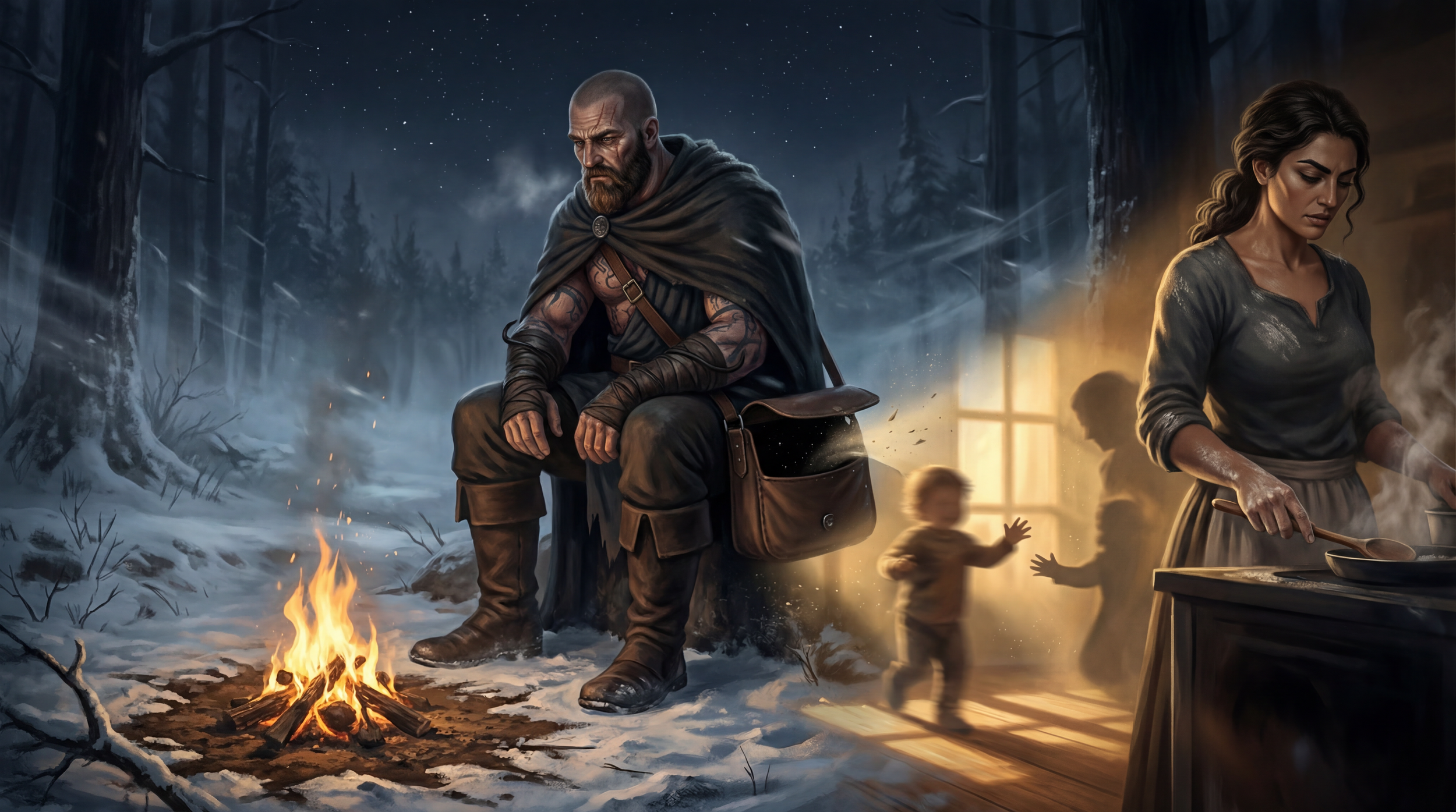
Founder walked north.
Not because north was holy. Not because the stars told him to. North was simply where the air got thin enough that men stopped pretending they were in control.
The satchel rode against his hip like it belonged there. Like it had always belonged there. Like the strap had been waiting for the exact shape of his shoulder.
He didn’t open it again that first night.
He didn’t need to.
The satchel wasn’t loud about its power. It didn’t demand attention. It didn’t glow or whisper like a cheap curse.
It did something worse.
It made the world around it feel more broken by comparison.
Every time the strap shifted, Founder felt it—just a breath of clean quiet under the leather. A tiny pressure of peace, like a hand at the back of his neck saying, “There’s another way.” He hated it immediately.
Not because it was false.
Because it was true.
The road was dirt and frost and old footprints. Trees leaned in like gossipers. The wind carried the smell of distant snow.
Founder moved like someone who’d learned not to waste motion. No flourish. No hurry. Just decision.
He walked until the light collapsed.
He made camp with the efficiency of a man who’d slept beside too many graves. Small fire. Low flame. No songs.
The satchel lay beside him like an animal pretending not to breathe.
Founder stared at it for a long time.
Then he muttered, not to the satchel, but to whatever part of the world still listened.
“I don’t want comfort,” he said.
The wind answered with a cold sigh.
He lay down.
He closed his eyes.
And the satchel opened anyway.
Not with buckles. Not with leather.
It opened the way a memory opens—
soft, sudden, absolute.
The cold vanished.
The fire’s crackle turned distant, like it belonged to someone else. The ache in his bones went quiet. Even the tension in his jaw eased, as if his body had forgotten it was supposed to brace.
Then a sound hit him.
Small feet.
Running.
Laughter—high and wild and real.
Founder’s eyes snapped open.
He wasn’t on the road.
He was standing in a kitchen washed with late-afternoon light. Warm boards under his boots. A window cracked open. The smell of soap and bread and the faint sweetness of something simmering.
A small voice shouted from the other room, bright as a thrown spark:
“Dad!”
Two shapes barreled into him.
Children.
His children.
He froze so hard it felt like his heart stopped.
Their arms went around his waist with the careless strength of kids who assumed a father was indestructible. One pressed their cheek against his coat. The other grabbed his hand like it had always been there.
“Where’d you go?” one demanded, grinning. “Mom said you were just outside!”
Founder’s throat closed.
He looked down at their hair—unkempt, sun-warmed, alive. He could smell them. Dust and apples and that clean animal warmth children have when they’ve been running.
His hands hovered above them like he didn’t trust himself to touch.
Then he did.
Fingers in hair.
A palm on a shoulder.
Real.
So real it made his stomach turn.
A voice came from the stove, amused and familiar in a way that hurt.
“You’re home,” she said, like it wasn’t a miracle.
Founder lifted his eyes.
His wife stood there with a wooden spoon in one hand, flour on her forearm, and that look on her face that said she’d been annoyed with him a thousand times and loved him through all of them.
Not a saint. Not a dream-girl.
Her.
The one who had existed. The one the broken world took.
She glanced over her shoulder, stirring, amused.
“Wash up,” she said. “Dinner’s almost ready.”
The children clung to him as he went, giggling about nothing important.
Founder’s hands dipped into warm water. Warm.
No blood.
No frostbite.
No shaking.
He stared at his reflection in the basin—softer, younger, less ruined—and his mind tried to fold itself into this shape.
Tried to believe.
Tried to let go.
Then he saw it.
On the wall by the door, hanging from a peg:
The satchel.
Not the road-satchel at his hip.
Another shape, another version—quiet, plain, innocent, like it belonged in a home instead of on a battlefield.
It wasn’t open.
But it was there.
A reminder.
A seam.
This wasn’t simply a memory.
This was the World of What Could Be letting him step inside its mercy.
Founder’s breath hitched.
And in that hitch, a voice—quiet as ink—slid into the room without disturbing anything.
Ledger.
“Count it,” they said.
Founder’s hands clenched on the basin’s edge.
His wife turned back to the stove, stirring, amused.
“Oh,” she said, quiet now. “Hey.”
And she kissed him.
Not a fantasy kiss.
Not a perfect, glowing thing.
A real kiss. Familiar. Warm. Slightly annoyed at first because he’d scared her—then turning soft because it was him.
Founder made a sound in his throat like something dying.
His children cheered and laughed behind him.
“Ew!” one of them shrieked, delighted.
“Dad’s crying!” the other sang, as if it was the funniest thing in the world.
Founder pulled back enough to look at them.
They were alive.
They were whole.
They were here.
His chest squeezed so tight it felt like punishment.
He could stay.
That was the temptation.
Not gold. Not power.
Not even peace.
Them.
A life rebuilt so cleanly it made the broken world look like a bad dream.
He looked at the table—three bowls set out. A half-finished little drawing. A toy on the floor. Ordinary evidence of a life that continued.
Founder swallowed hard.
He could stay.
He could stop hurting.
He could let the broken world rot without him.
His wife turned back to the stove, stirring, humming softly now.
“Wash up,” she said. “Dinner’s almost ready.”
The children dragged him toward a basin, chattering about nothing important—school, a scraped knee, a neighbor’s dog—tiny nonsense that sounded like heaven.
Founder understood the cruelty of the satchel**’s** mercy.
It would show him what he wanted most.
Not to torture him.
To measure him.
To see if the man he**’d** become could still choose the harder path.
Founder**’s** mouth trembled.
He didn’t need to look again to know it was still there.
He opened his eyes, seeing his children again.
“I’m here,” she said. “We’re here.”
Founder’s hands shook as he peeled their fingers away, gentle, impossibly gentle.
“I'm sorry," he whispered. "I'm sorry. I'm sorry."
His wife’s face fell in concern.
“Why?”
Founder didn’t answer.
He turned.
He walked through the doorway.
And the world snapped. Cold slammed into him all at once: the harsh wind, the thin fire, the dirt road beneath his feet.
Founder stumbled forward until he was sure he’d left everything behind—wife, children, the life that could’ve been. He turned and spat onto the ground in front of him.
“Bastard,” Founder muttered under his breath.
The satchel at his side didn't open or close—it simply remained there like it had always been, a constant weight on his hip.
He walked.
“You walked out,” they said.
Founder’s voice came out ragged. “It shouldn’t be able to do that.”
“You’re carrying it,” Ledger replied. “It can’t not touch you.”
Founder wiped his face with the back of his hand like the gesture could erase weakness.
“What happens if it does it again?” he asked.
Ledger paused—just long enough to feel like a blade deciding where to cut.
“It will,” they said. “It will keep offering. That is what it is. It is What Could Be. It does not understand why you would choose What Is.”
Founder stared into the dark.
The stars looked sharper now, like they were angry.
He swallowed.
“Then why choose me?”
Ledger’s voice was quiet, inevitable.
“Because you can say no,” they said. “And keep walking anyway.”
Founder lay back down, but sleep didn’t come easy after you’ve held your dead children and smelled your wife’s hair again.
He watched the fire die.
He listened to the wind.
And in the last thin moment before dawn, he spoke into the dark, not sure if it was a promise or a threat.
“Fine,” he whispered. “Lead.”
Inside the satchel, Ledger counted the word like a coin dropped into a bowl.
And the road—real road—opened ahead.
North.
Toward stone.
Toward storm.
Toward Grandfather Ash.
