
THE WORLD OF WHAT COULD BE
Ledger
Before there was “before.”
Before the first hunger learned to call itself a god, before pain invented language so it could describe itself—there was a place that did not need to be explained because it was not a consequence of anything.
It simply was.
A realm with no Wounds.
No Tear.
No Maw.
A realm where the world could exist without paying for existing.
It didn’t have a name then. Names are nails hammered into moving things.
Later, beings called it what they were capable of understanding:
A garden.
A seam.
A lantern.
A library.
A hearth.
A pocket.
A doorway.
A lover’s hand.
A coffin.
A satchel.
It has worn a thousand shapes because it never required a single one.
And it has endured every age because it is not in time the way the broken world is.
It is the place reality returns to when it wonders what it might have been.
The place the universe keeps like a secret.
Most beings brush against it once in their existence—by accident. A dream they can’t explain. A sudden warmth in the middle of grief. A moment where the world feels… less cruel… and they don’t know why.
Then it’s gone.
Because the broken world doesn’t like reminders.
But for one being—only one—it was never a brush.
It was home.
LEDGER
Ledger had always been there.
Not trapped. Not hiding.
Native. Like a law is native. Like gravity doesn’t need permission to exist.
If the World of What Could Be was a body, Ledger was part of its nervous system—how it noticed, how it remembered, how it answered without letting the broken world smear itself across the seam.
Ledger did not dream.
Dreams are for beings who need escape.
Ledger existed where escape was unnecessary.
So they did what they were made to do:
They kept count.
Not years. Not coins. Not mortal trivia.
They counted choices.
Every moment the broken world almost turned kind—and didn’t.
Every near-miss where love could have won—and failed.
Every time pain presented itself as “the only way” and was believed.
Ledger counted, too, the approach of a particular weight.
Not prophecy. Not romance.
Inevitability.
A man shaped like a carrier.
Founder.
Not yet called that—names come after witnesses—but already built from refusal: the kind of refusal that keeps walking when walking stops being brave and starts being stupid.
When Founder first touched the satchel, Ledger felt it like a bell struck deep under water.
Not because the satchel was being opened.
Because the right hands had finally found the seam.
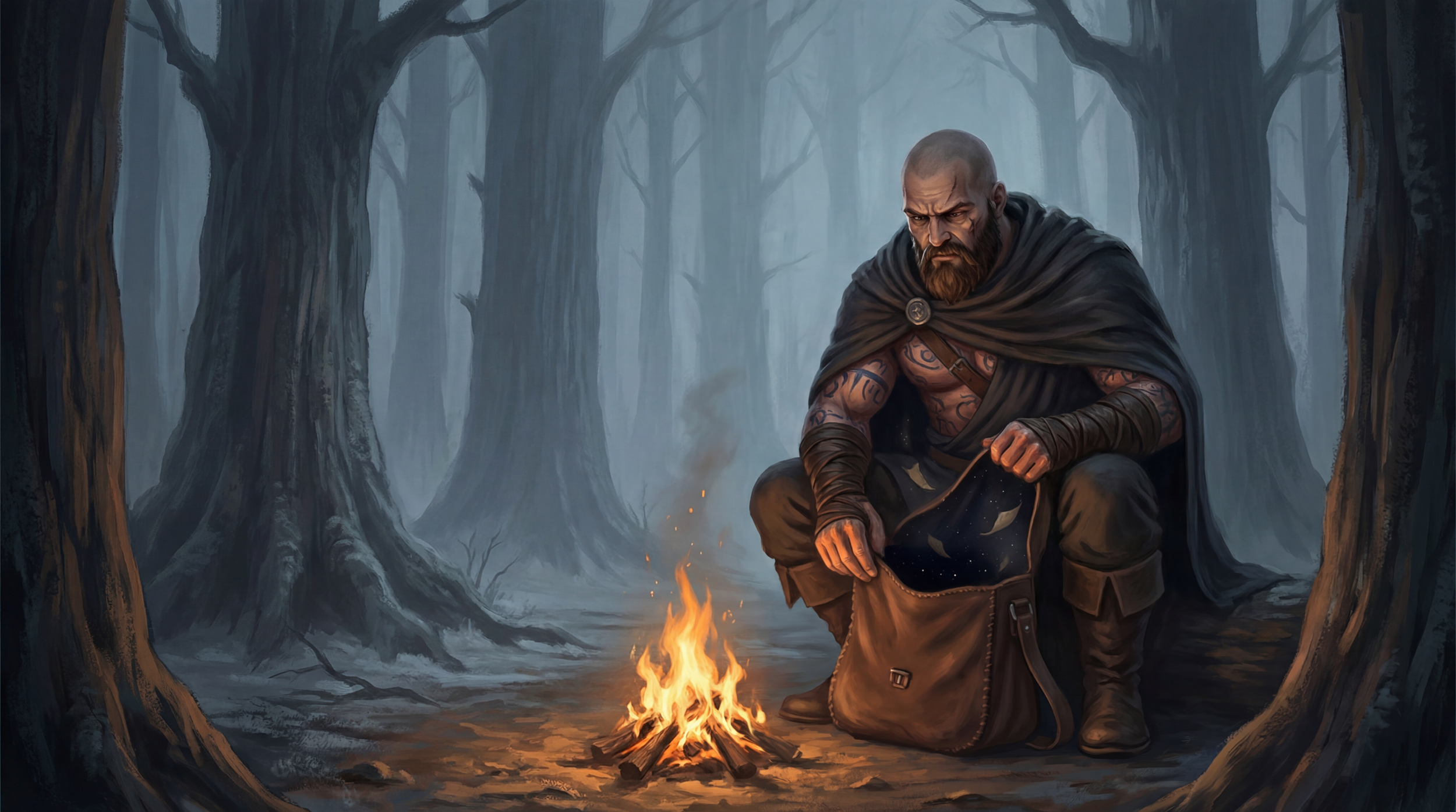
To Founder, it looked like a satchel because Founder could only understand salvation if it had a strap and a burden. If it could be slung over a shoulder. If it could be borne without ceremony.
He carried it for days before he dared to open it.
One night, with wind worrying the trees like a warning, Founder lit a small lantern and pulled the mouth of the satchel open.
He expected stink.
Rot.
The hot breath of something hungry.
Instead he felt something that made his stomach twist with sudden nausea:
Relief.
A cleanliness so complete it didn’t feel like comfort.
It felt like accusation.
Like stepping into a room where nobody had ever screamed and realizing how loud your own history is.
He stared into that impossible dark.
Knife half-drawn without meaning to.
And Ledger spoke.
Not grand. Not theatrical.
Just certain—like ink deciding it will become law.
“You’re late,” Ledger said.
Founder went still. “Who’s there?”
“I am,” Ledger replied. “And you are exactly where you were always going to end up.”
Founder’s jaw tightened. “I don’t do fate.”
“Call it gravity,” Ledger said.
The lantern flame shivered.
Founder leaned closer, trying to turn the unseen into something he could fight.
“What is this?”
“This is the world your world forgot it had,” Ledger said.
Silence stretched. The kind that makes men want to ruin it just to prove they still can.
Founder swallowed. “Why show me?”
“Because you’re going to walk the road either way,” Ledger said. “The only difference is whether you walk blind… or whether you walk with me.”
“And what are you?” Founder asked.
“I’m what this place uses to speak to what broke,” Ledger replied.
Founder held that like a man testing a blade’s balance.
“Where does your road go?”
Ledger gave him the first direction of the journey.
“To Grandfather Ash.”
Founder frowned. “A person?”
“A mountain-spirit,” Ledger corrected. “A witness. An anchor. Old enough to teach you weight without turning it into shame.”
Founder stared into the satchel again, and the darkness stared back—not hungry, not eager, just waiting.
“As you walk,” Ledger added, “this place will tempt you.”
Founder’s mouth twitched. “Tempt me with what?”
“With the version of your life that didn’t get ruined,” Ledger said. “With peace. With sweetness. With could have been.”
Founder went quiet.
Pain was familiar. Pain was simple.
But a world without pain?
That could make a man stop walking forever.
Founder closed the satchel.
But the way he carried it changed.
Not like a tool.
Not like loot.
Like a promise he didn’t remember making.
And deep inside the World of What Could Be, Ledger listened to the shift in his footsteps—the moment they stopped being wandering and became a path.
“Good,” Ledger whispered into the seam.
“Now we begin.”
—-
Author’s Note:
This isn’t the first story—it's the moment the stories become a road. After everything already written, this is where we lay our hand on the map and say: now we walk. Founder has found the seam, and Ledger has finally answered. From here, the journey to Grandfather Ash begins in earnest—alongside the temptations of “could have been,” and the forces that won’t let him carry hope unchallenged.
